Professor Bassam Z. Shakhashiri,
Director of the Wisconsin Initiative for Science Literacy
First Holder of the William T. Evjue Distinguished Chair for the Wisconsin Idea 
The Wisconsin Idea proclaims, "The boundaries of
the University are the boundaries of the state." It means that the University
should not be an ivory tower institution but should serve all the people of
the state in relevant ways. This may seem obvious today, but in the mid-19th
century it was revolutionary. At that time, most institutions of higher education
were private schools which emphasized a "classical" education in Greek
and Latin, and few people were privileged to attend.
No one knows who coined the phrase "Wisconsin Idea"
or when, but as early as 1858 a state legislative committee defined the role
of a state-supported university:
"The
general government has made a munificent donation to the people of Wisconsin.
They have an unquestioned right to demand that it shall primarily be adapted
to popular needs, that its courses of instruction shall be arranged to meet
as fully as possible the wants of the greatest number of our citizens."
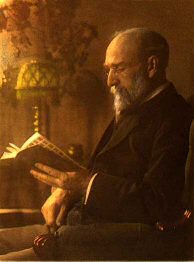
Charles R. Van Hise In 1906, University President Charles Van Hise said,
"I shall never be content until the beneficent influence of the University
reaches every family in the state." [1]
The Wisconsin Idea became nationally famous. In 1912
Theodore Roosevelt, impressed by the way in which Wisconsin had achieved substantial
improvements without resorting to sweeping experiments, declared that "all
through the Union we need to learn the Wisconsin lesson of scientific popular
self-help, and of patient care in radical legislation." [2]
In recent decades the borders of the University have
expanded to the borders of the nation, the world and beyond. Today the
University draws students from around the world, sends researchers to every
part of the world, and sends experiments into space.
Among the University's pioneering efforts:
The Wisconsin Idea has also fostered a long partnership
between the University and government. University of Wisconsin Law School graduates
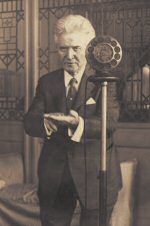
Robert M. La Follette Sr. and his wife Belle Case La Follette founded the Progressive
Party which promoted many reforms including civil service, primary elections,
and direct election of US senators. "Fighting Bob" La Follette served
as Wisconsin governor and U.S. senator. Belle Case La Follette was the first
woman to graduate from the University of Wisconsin Law School, in 1885. In the
early 1900s, Professor John R. Commons drafted the state's first civil service
law and helped draft the nation's first worker's compensation law. In the 1930s,
University Professor Edwin Witte, along with other faculty and graduate students,
drafted the nation's first unemployment compensation law and Social Security
legislation. Law Professor Frank Turkheimer served as a special counsel for
the Congressional Watergate hearings in 1974. More recently, Political
Science Professor Don Kettl chaired governor's blue ribbon commissions on campaign
finance reform and the relationship between state and local governments. These
are just a few of the many faculty who have advised governments.
Many University graduates have held government positions.
In 1976 Shirley S. Abrahamson
(S.J.D., U.W. Law School 1962) became the first woman to serve on the state
Supreme Court. In 1996 she became the first woman Chief Justice. Tommy
G. Thompson (B.S. 1963, J.D. 1966) was the longest-serving Wisconsin governor
(1987-2001) and now serves as Secretary of Health and Human Services. Eight
of Wisconsin's last ten governors were graduates of the U.W.-Madison. In addition
to Thompson they are: Vernon Thomson (B.A. 1927, LL.B. 1932), Gaylord Nelson
(LL.B. 1942), John Reynolds (Ph.B. 1946, LL.B. 1949), Warren Knowles (LL.B.
1933), Patrick Lucey (B.A. 1946), Lee Sherman Dreyfus (B.A. 1949, M.A. 1952,
Ph.D. 1957 – Dreyfus was also a Professor of Communication Arts at U.W.-Madison
and Chancellor of the U.W.-Stevens Point), and current governor James Doyle
(B.A. 1967).
Some 2250 University graduates have entered the Peace
Corps, more than any other university.
The University is a leader in research which has often
led to applications that have improved the quality of life for everyone. For
example, Wisconsin's dairy industry would not be possible without the pioneering
agricultural research conducted by University faculty starting in the 1880s
and continuing today. Many University faculty saw no clear dividing line between
basic research and applied research. Much of their research has been aimed at
solving specific problems, but they assumed that all research would eventually
provide concrete benefits. In 1933, some farmers asked Professor Karl Paul Link
why eating spoiled sweet clover made their cows bleed to death. Link found and
synthesized dicumarol, a blood thinner which impedes coagulation. Eventually,
Link made more than 100 variants of dicumerol. Some are used in human medicine
and have saved the lives of thousands of people in danger from blood clots.
Another variation, Warfarin, is one of the most efficient rat poisons ever invented
and is used around the world. Warfarin was named for the Wisconsin Alumni Research
Foundation. Link gave the patent to the Foundation, which has made tens of millions
of dollars from it and used the money to fund more research.
Wisconsin has also been a leader in the environmental
movement. John Muir (x1864) is considered the father of the national park system
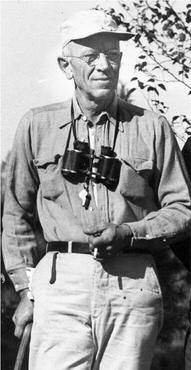
and founded the Sierra Club. Professor Aldo Leopold founded the study of wildlife
ecology and his 1949 best-selling book A Sand County Almanac (referring
to Adams County, Wisconsin) is a classic which still sells briskly today. Former
Wisconsin governor and U.S. Senator Gaylord Nelson (LL.B. 1942) founded Earth
Day.
Three Nobel Prize winners carried out their research
at the U.W.-Madison. In 1958 Professor Joshua Lederberg won the Nobel for discoveries
relating to genetic recombination. In 1970 Biochemistry Professor Har Gobind
Khorana won the Nobel for the first synthesis of a gene. In 1975 Oncology Professor
Howard Temin won the prize for discovering retroviruses. Today the University
is a world leader in stem cell research under Professor James Thomson, who was
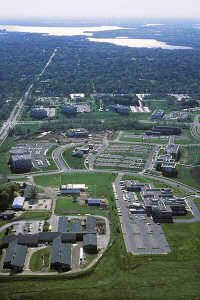
the first to develop a replicating strain of stem cells. The University established
a research park in 1983
under Chancellor Irv
Shain. The park now has 88 tenants more than half of which directly
apply University research. The University renewed its commitment to the Wisconsin
Idea in 2000 with the creation of the William T. Evjue Distinguished Chair for
the Wisconsin Idea, endowed by the Evjue Foundation. Professor Shakhashiri
was appointed the first holder of the chair in 2001. The University also
established Wisconsin Idea Fellowships. As part of the re-accreditation process
and expansion of the Wisconsin Idea under Chancellor David Ward and Provost
(now Chancellor) John Wiley, the University re-organized and increased co-ordination
of the outreach efforts already under way by many schools and departments of
the University.
The Wisconsin Initiative for Science Literacy is proud
to continue this long tradition of bringing the benefits of University education
and research to everyone.
The Evjue Foundation
The Evjue Foundation is the charitable arm of the The
Capital Times newspaper in Madison. The Foundation was established in 1970 by
the will of William T. Evjue, founder and longtime publisher of The Capital
Times. The Foundation makes more than one and a half million dollars in grants
each year to educational, cultural and charitable organizations.
References
Robert
M. La Follette, Sr.
Aldo Leopold
University
Research Park
- From The Wisconsin Idea in the 1995-1996 Wisconsin
Blue Book, compiled by the Wisconsin Legislative Reference bureau
- From The Bulletin of the University of Wisconsin, Vol. 1962, No. 11.
Further Reading
Sifting and winnowing turns 125: The tumultuous story of three little words
UW News
John Nichols: Tony Evers won as the Wisconsin Idea candidate
Madison.com
The Wisconsin Idea and its History
UW Website
A Study In Scarlet
Distillations Magazine
Science History Institute
Law that radically changed UW signed 150 years ago
UW News
New monument pays tribute to the Wisconsin Idea
UW News
Wisconsin Idea: The University's Service to the State and The Wisconsin Idea for the 21st Century
Legislative Reference Bureau