Pure water does not conduct electricity very well. However, when some materials are dissolved in water, the solution
is a very good conductor of electricity. When other things are dissolved, the solution may conduct poorly, or not at
all. You can build a conductivity tester that uses a light bulb to indicate how well a solution conducts electricity.
Here's how.
You will need the following materials:
- a 12-volt A.C. transformer
- This transformer plugs into a household electrical outlet and reduces
the voltage from 120 volts to 12 volts A.C. Make sure the transformer produces A.C., not D.C. A D.C. power supply won't
work. A suitable transformer can be obtained at a Radio Shack store, the catalog number is #######.
- a 12-volt light bulb and socket
- You can get this from Radio Shack, too. The catalog numbers are ##### for the bulb
and ##### for the socket.
- a 12-inch piece of 12 gauge, single strand, insulated copper wire
- This you can get from a hardware store.
- two round-head 3/4 inch wood screws
- You can get these at the hardware store, or a lumber yard.
- a block of wood
- A six-inch piece of 1 by 2 is ideal; you can get this from the lumber yard.
- adhesive tape
- Electrical tape or duct tape will do nicely.
In addition to these materials, you will need some tools: a wire stripper, a flat-blade screw driver, and pliers.
Here's how to assemble the tester.
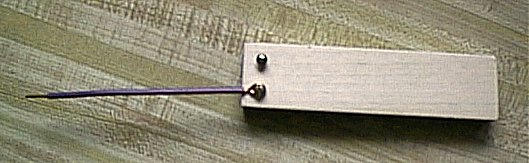
- Cut the 12-inch piece of insulated, single-strand, 12-gauge copper wire into two 6-inch pieces. Strip 1 inch of insulation
from one end and 1/4 inch of insulation from the other end of each wire.
- Screw the two screws into the block of wood, about 1/2 inch from the end of the block and about 1 inch apart. Before tightening
the screw, wrap the 1-inch section of bare copper wire around the screw. A pair of pliers can help with this.
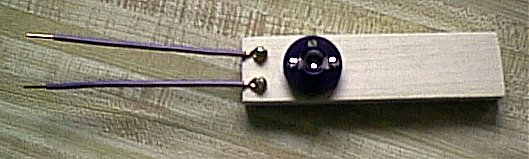
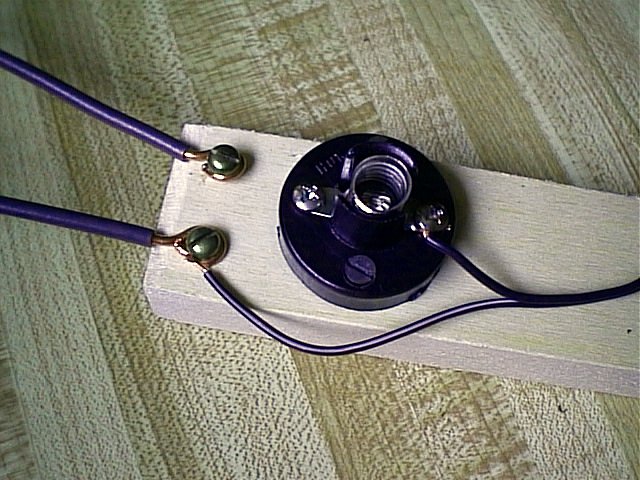
- Attach the second wire to the other screw in the block of wood. Mount the light-bulb socket onto the block of wood near the
screws.
- Remove the connector from the end of the cable of the transformer. Separate about six inches of the two wires at the cut end of the
cable. Cut a 4-inche piece off the end of one of the wires, and save this piece. Strip about 1 inch of insulation from the end of the two wires
of the transformer. Attach the shorter wire to one terminal of the light-bulb socket. Attach the longer wire to one of the screws holding
a 12-gauge wire.
Back to Home Experiments