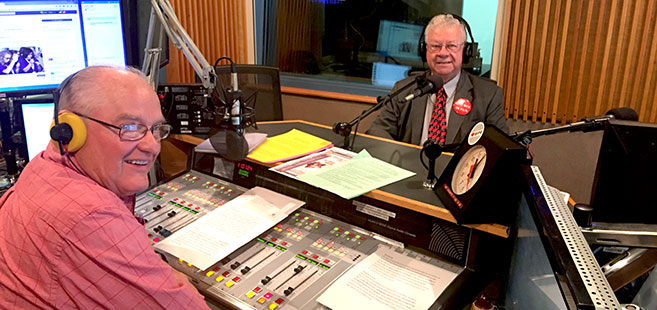
Professor
Shakhashiri is a frequent guest of the Larry Meiller Show
on the Ideas Network of Wisconsin Public Radio.
Back to Radio Main Page
December 2, 1999, Larry Meiller Show
On the December 2 program, the discussion included the following topics in response
to questions raised by host Larry Meiller and to calls from listeners:
November
4, 1999, Larry Meiller Show
On the November 4 program, the discussion included the following topics in response
to questions raised by host Larry Meiller and to calls from listeners:
-
National Chemistry Week as declared
by the President and the US Congress is November 7-13, 1999 in recognition of
the importance of chemistry in our daily lives. Across the country thousands
of chemists and chemical engineers will be reaching the public with presentations
and public events aimed at communicating the significance of chemicals, particularly
polymers, in all aspects of our lives. In Madison, University Bookstore for
Kids is featuring Professor Bassam Z. Shakhashiri in a public presentation at
Hilldale Mall on the afternoon of November 7.
-
Chemistry is the "central" science and it is one of the most active, exciting,
and productive areas of the scientific frontier. It is also an important part
of the educational system. Chemistry is a major player in the development of
new products and services and it has profound effects on the day-to-day functioning
of our society.
Below are several displays of the Periodic Table of Elements which are highly
attractive and informative:
- The American Chemical Society, is the
world's largest scientific society with about 170,000 members. Every year, about
11,000 bachelor's degrees and about 2000 Ph.D. degrees are awarded in the United
States.
- Some of the top developments in chemistry in the 20th century include: Nylon
the first synthetic fiber and other polymers such as polyethylene and Plexiglass,
Aspirin, Tylenol, Cellophane, Drano, Crisco, Kleenex, Alka-Seltzer, Kodachrome,
Dial soap, Dramamine, cyclamate, saccharin, and aspartame sweeteners, anti-depressants,
aluminum cans, toothpaste with fluoride, antibiotics, Bucky balls, superconductors,
microchips. Rachel Carson's Silent Spring book in 1962 raised the awareness
about the effect of chemicals on the environment, detonation of nuclear bombs,
deciphering of the genetic code by UW biochemist, Har Gobind Khorana, Vitamin
D research by UW biochemist Steven Babcock and his students.
- The US Congress continues to provide significant funding for research and
education in science and technology. For example, The National Institutes of
Health are slated to receive a 15% increase for the second year in a row. Such
support, along with the funding from the private sector and state government
helps make our US research and development efforts the most pre-eminent the
in the world.
- The 30th presentation of ONCE UPON A CHRISTMAS
CHEERY IN THE LAB OF SHAKHASHIRI will be on December 11 and 12.
October 7, 1999, Larry Meiller Show
On the October 7 program, the discussion included the following topics in response
to questions raised by host Larry Meiller and to calls from listeners:
- The colors of autumn leaves and what causes the colors. For information
check:
http://scifun.chem.wisc.edu/chemweek/fallcolr/fallcolr.html
- American Association for the Advancement of Science statement on middle
school science textbooks and their shortcomings. For mmore details visit the
web site: Project 2061
- Programs for gifted and talented students especially those of the Wisconsin
Center for Academically Talented Youth WCATY.
- Failure of the 125 million dollar Mars Climate Orbiter was due to expressing
the units of force in the English system (pounds) rather than in the Metric
system (newtons). For more information on the metric system visit the web site:
Go Metric
September 2, 1999, Larry Meiller Show
On the September 2 program, the discussion included the following topics in response
to questions raised by host Larry Meiller and to calls from listeners:
-
The excitement and meaning of the beginning of another academic year at all
educational levels.
-
Some of the planned activities to celebrate the 30th Anniversary of
my being a faculty member at UW-Madison.
-
The action taken last month by the Kansas Board of Education to exclude questions
on evolution and the big bang theory from state tests. This action has
generated considerable discussion. For more insight and information here
are a few recommended websites:
June 22nd, 1999, Larry Meiller Show
On the June 22nd program, the discussion included the following topics in response
to questions raised by host Larry Meiller and to calls from listeners:
- The Summer Solstice
- June 21 marked the summer solstice. What does the summer solstice mark?
Callers quickly provided correct answers: the summer solstice occurred at
2:49 p.m. CDT when the earth's Northern Hemisphere was tilted most directly
toward the sun and we enjoyed the most daylight hours of the year-- 15½
hours in Wisconsin. In the Southern Hemisphere winter began.
- The Seasons
- Studies show that a significant portion of the population is unable
to correctly answer the question: Why are there seasons? Callers correctly
explained that the tilt in the earth's axis of rotation is the cause of
the seasons.
Responses to the following questions were solicited from and kindly provided
by astronomer Frank D. Drake, who is president of the
SETI Institute.
- Why does the earth tilt?
- It is believed that all the tilts in the solar system are a result of
hits by large objects, most of which hits occurred during the time of "the
heavy bombardment", which ended 3.8 billion years ago (sun and Earth are
4.5 billion years old). Uranus and Venus even had their rotations reversed.
Pluto maybe, too, although its history is more of a puzzle. The object which
collided with Earth to make the moon was almost the size of Mars, and probably
caused most of the tilt. The Pacific Ocean may be partially a scar from
that event, which was almost powerful enough to demolish the Earth.
- Does the moon rotate at the same speed as the earth? That is, why don't
we see the dark side of the moon? Does the moon tilt too?
- Interesting story here. First, there is no "dark side" -- a common mistake.
There is a "far side." The appearance of the moon is governed by: (1) Its
rotation period is exactly the same as its orbital period. Thus we would
always see exactly the same face except:( 2) The orbit is elliptical, and
thus the moon moves in its orbit faster at some times than others; (3) The
rotational axis of the moon is tilted 6.5 degrees with respect to the orbit
and 4) The observer is riding on a rotating Earth. This combination of facts
leads to the so-called "librations" of the moon. There are three always
described in modern textbooks:
- the moon wobbles slightly (about 7 degrees) from east to west once
in the course of a lunation (roughly a month). This is because the moon
moves at different speeds at different times each orbit. This is the
monthly libration in longitude.
- The moon wobbles slightly from East to West, about one degree, in
the typical twelve hours it is visible to any observer. This is because
the observer is carried from one "limb" of the Earth to the other in
those twelve hours, so we are looking toward the moon from a different
position, from a moving platform, so to speak. This is parallax. This
is the daily libration in longitude.
- The pole of the moon nods towards us and then away from us (by 6.5
degrees) once in the course of a lunation. This is the monthly libration
in latitude.
You can see an animation of these motions as several Web sites, such
as
www.minervatech.u-net.com/moon/not_libr_ac.htm
Historically, the lunar librations were the last discovery of Galileo. He
was very proud of this discovery. I am having a long discussion with author
Dava Sobel right now because she has translated Galileo's descriptions of
the librations, and if the translation is right he has made a mistake. We
are trying to figure out if he really made a mistake or is his use of scientific
terms or Dava's translation not what he intended. He seems to have missed
the daily libration, although he should have seen it. He also describes
a fourth libration, which is there but never mentioned in the text books,
which is that the axis of the moon at full moon seems to tilt from left
to right in the course of a year -- he describes it (and the other librations)in
terms of the appearance of a person's face. In this case, he describes the
libration as the person leaning their head toward one shoulder and then
the other. this one is again a result of the tilt of the moon's rotation
axis. I don't know why modern astronomers ignore this one completely. Possibly
because it doesn't bring more of the "far side" into view -- the other three
librations all cause us to see, in the course of the month, more than half
the moon. Actually we see a total of 59 percent of the lunar surface.
Dava Sobel's book is not published yet, but will be in the Fall. Its title
is Galileo's Daughter and it will be published by St. Martin Press.
- What causes earth's magnetic field to change? A caller asked if his compass
that points N would "switch" and point S?
- The Earth's magnetic field is generated by electrical currents in the
Earth, which are in turn generated by random motions of hot, electrically
conducting, molten rock in the interior of the Earth. Much of the interior
is moving like boiling water in a pot, do to heat supplied from the Earth.
The motion is much slower, however, typically a few inches a year! But this
"convection" produces the currents and magnetic field (as it does in other
planets). When the pattern of motions changes, as in a pot of boiling water,
the magnetic field changes. Sometimes the field even goes to nearly zero,
and sometimes it reverses polarity.
And yes, when the polarity changes a compass would reverse the direction
it points.
- The colors of the aurora are cause by which elements? oxygen emits more
than color?
- The aurora is caused almost entirely by high velocity hydrogen atoms
which have been expelled from the sun in solar flares. When they strike
the Earth's atmosphere they cause the atoms and molecules to be energized
and to release light in many spectral lines. The blue and green colors come
almost entirely from oxygen atoms which have been energized by the hydrogen
atoms. The red colors come from the hydrogen atoms themselves.
- If an object is coming toward the earth at the speed of light will we see
it?
- If it were moving at exactly the speed of light, we would see it as
a brilliant instantaneous flash. The light from it would arrive at exactly
the same time as the object, and there would be an enormous flash. However,
relativity tells us that no object can be accelerated to exactly the speed
of light, so in reality the light would always arrive slightly before the
object. Again, since all the light emitted over a great length of time would
arrive at almost the same time, we would see a brilliant, short, flash of
light and other electromagnetic radiation. Exactly this effect is seen in
the so-called "synchrotron radiation" of highly energetic electrons in space,
and in clouds of electrons expelled at near-light velocities in quasars.
My very special thanks to my brother-in-law Frank Drake for the above contributions.
May 12th, 1999, Larry Meiller Show
On the May 12th program, Prof. Shakhashiri and host Larry Meiller discussed a
range of topics that included the following:
April 13th, 1999, Larry Meiller Show
On the April 13th program, Prof. Shakhashiri and host Larry Meiller were joined
by Sarah Lauffer, who holds a Master of Science degree from the UW-Madison, in a
discussion that included the following topics:
March 4th, 1999, Larry Meiller Show
On the March 4th program, the discussion included the following topics:
- The importance of science in society. Of the top 25 news stories of this
Century as reported in a recent survey of journalists and scholars, 11 are science-related
including: the atomic bomb, the discovery of penicillin, Neil Armstrong's walk
on the moon in July 1969.
- Glenn Seaborg who was a leader in the Manhattan Project which developed
the first A-bomb died on February 25, 1999 at age 86. He was co-discoverer of
10 elements beginning with Plutonium, element 94, in 1940 and Seaborgium, element
106 (named after him) in 1974. Dr. Seaborg was an outstanding leader in science
and science education. He and I presented public lectures on science in the
1980s entitled SUNDAY AFTERNOON WITH SCIENCE at national meetings of the American
Chemical Society and Westinghouse Talent Searches.
- What is science? What is the purpose of research? How have advances in science
and technology resulted in changing society (transportation, agriculture, housing,
medicine, etc.).
- The difference between science, pseudo science, and science fiction. One
caller recommended the two books that he just finished reading, and I recommend
them too:
- The Demon-Haunted World: Science As a Candle in the Dark, by
Carl Sagan, Random House (1996).
- Unweaving the Rainbow:Science, Delusion and the Appetite for Wonder,
by Richard Dawkins, Houghton Mifflin (1998).
- Nobel Prize winner Torsten Weisel's recent advice to scientists: get out
of the lab and into the public arena of public debate on science and societal
issues.
- Science literacy and improvements in the public understanding of science.
- Linking science to ethics.
January 28th, 1999, Larry Meiller Show
On the January 28th program, the discussion included the following topics in
response to questions raised by guest host Jim Packard and to calls from listeners:
- How the 17.5% increase in Federal spending for basic research in fiscal
year 1999, to $17.5 billion, will affect the University of Wisconsin.
- The first woman to receive
The National Medal
of Science for work in Mathematics is NYU Professor Cathleen Synge Morawetz.
She says she hopes the medal will show that women can to math, too.
- The Arise Project
in which the topics in science education are reordered, with physics first,
ahead of biology and chemistry.
- Polls show that the nation's top domestic priority is education. Governor
Thompson stressed education in his State of the State address. President Clinton,
in his State of the Union address, proposed that the federal government set
guidelines for teacher training, student discipline, school performance, and
promotion policy. Those that do not meet the guidelines could lose federal funding.
Click for information about recent shows
Back to Science is Fun Home Page