| Professor
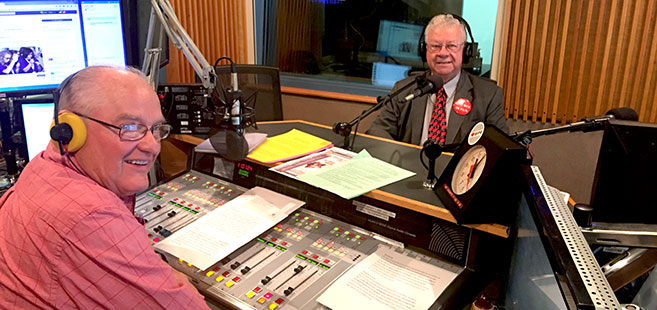
Shakhashiri is a frequent guest of the Larry Meiller Show
on the Ideas Network of Wisconsin Public Radio. His next appearance
is to be announced.
Below
is some information about past shows.
Past Appearances 2007,
2006, 2005, 2004,
2003, 2002, 2001,
2000,
1999, 1998, 1997
and earlier
- Larry began by
asking about the cabinet appointments of president-elect Obama.
Obama’s nominee for Education Secretary, announced shortly
before the show, is Chicago Superintendent of Schools Arne
Duncan. Professor Shakhashiri said it’s not surprising that
Obama called on someone he knows and that Duncan has accomplished
quite a lot in Chicago. Professor Shakhashiri noted that big
city school districts are in trouble with issues like finances,
the quality of teachers, the quality of facilities and the
curriculum. Professor Shakhashiri said these problems need
a fresh look and he’s hopeful that the administration will
provide it. Obama’s choice for Secretary of Energy is Nobel
laureate Steven
Chu, who has been director of the Lawrence Berkeley Laboratory,
where he focused on climate issues. Chu would be the first
Nobel laureate to serve in the cabinet, and Professor Shakhashiri
said he brings a lot of credibility to the job, though Professor
Shakhashiri added that the job is not scientific but political.
Professor Shakhashiri said Obama’s entire list of appointees
is promising, but he warned against expecting too much. The
President and his Cabinet will face severe economic and human
issues, and Professor Shakhashiri said concerned citizens
should keep the pressure on elected officials to make progress
on issues like climate change, education and health care,
all of which have a basis in science. At the time the program
was broadcast, Obama had not announced his choice of science
advisor.
- Larry asked if
scientists can make good politicians. Professor Shakhashiri
said one example is former British Prime Minister Margaret
Thatcher, who has a PhD in chemistry. While she has many critics,
Professor Shakhashiri said Thatcher was a strong leader, and
he added that scientists bring sound judgment on scientific
issues. Professor Shakhashiri said the entire Obama team is
promising, but citizens should be realistic about their expectations.
- A caller who
identified himself as a scientist expressed concern about
scientists as politicians because, he said, they don’t have
a real human touch. The caller described a graduate management
class in which students were given the example of a troublesome
employee. While other students proposed various solutions,
he said the engineers in the class all said the employee should
be fired. While the caller said he wants scientists in government,
he also said, “I want politicians to have more of the human
touch than the scientists I know.” Professor Shakhashiri said
scientists are caring people, though they don’t always show
it. Steven Chu is an accomplished researcher, he said, who
also cares about issues as they effect society– otherwise
he would not have taken the cabinet position, which will not
advance his science career. Professor Shakhashiri said scientists
are needed in government to bring sound judgment on science-related
issues, but agreed that they also need to bring out human
aspects of their work.
- Larry asked about
a new international study of science and math education which
showed that, while students in the fourth and eighth grade
in the U.S. still lag behind their counterparts in many countries,
there has been some improvement in American math scores. Professor
Shakhashiri said that while the U.S. doesn’t need to be number
one, such comparisons serve as a timely warning. President
George H.W. Bush in 1989 set a goal of making the U.S. number
one by 2000, but Professor Shakhashiri said he’s not sure
what being number one would mean. The question, he said, is
whether students are being properly prepared for higher education
and for work. Professor Shakhashiri called for improving education
in all areas because education is the key to progress. While
the trends are disturbing, Professor Shakhashiri said he would
not trade the U.S. educational system for any other because
it offers diversity and freedom. However, while diversity
is good, Professor Shakhashiri called for national education
standards, though he added that the federal government should
not mandate them. He also called for leadership and involvement
from students, parents, teachers and communities. For more
about the Trends in International Mathematics and Science
Study (TIMSS), please click here.
- Larry asked about
a new study from the National Research Council calling for
a plan to assess the potential health and safety risks in
the use of nanotechnology. Professor Shakhashiri said the
warning is timely and, while science and technology are making
great progress, everyone should be concerned about safety.
Professor Shakhashiri said there are always misunderstandings
about such reports, and the report was not issued to frighten
people but to raise issues and provide a platform for discussion.
He added that his colleagues are concerned about the issue
and that everyone should be aware of potential consequences.
For more about the NRC please click here.
- A caller applauded
the Obama appointments and said science is being restored
to a place of honor. But the caller also worried about the
cost of higher education, which is going up faster than inflation,
and the affordability of higher education for ordinary people.
Professor Shakhashiri said the caller raised an important
point and that a hard look is needed at how we fund education–what
fraction should come from governments at various levels and
what percentage from the private sector, which invests heavily
in higher education. Professor Shakhashiri said education
is a business, the business of developing talent, and all
citizens should have the opportunity to develop their talents
to the fullest. Professor Shakhashiri noted that there are
scholarships and grants in aid for needy students, part of
the federal government’s effort, but it remains to be seen
how this will be affected by difficult economic times and
budget problems at all levels of government.
- A caller said
he has two grandsons. One, in college, has decided to be a
teacher, but he said the other, in high school, likes science
but is getting conflicting advice on what field to go into.
The caller said there are more opportunities today than in
the past, but that makes the decision complicated, and he
wondered where to turn for advice. Professor Shakhashiri urged
the caller not to push the student to make decisions now,
but rather let him learn about his options and enjoy learning.
Professor Shakhashiri urged the caller to give the student
books on various science topics (see “Recommended Reading”
in this web site). He also noted that school counselors and
teachers can give advice as well as parents and other family
members. Professor Shakhashiri said the grade point average
in various subjects is only one indicator of ability and inclination,
and urged patience and the nurturing of curiosity.
- Another caller
had two concerns: He said seniors are no longer able to take
courses for credit free of tuition at the University of Wisconsin-Madison,
and said they should be able to. He also complained about
the high cost of textbooks. Senior citizens can audit courses
free of charge with the permission of the instructor, but
they are not able to take courses for credit free of charge.
Professor Shakhashiri said he agrees with the caller about
the price of textbooks, which now cost university students
an average of nearly $1000 a year. He said textbook publishers
must be more accountable. While costs may be moderated somewhat
by materials posted on web sites, Professor Shakhashiri doesn’t
want all learning shifted from the classroom to the internet.
- A caller asked
about reports that plastic bottles containing bisphenol A
can leach harmful chemicals into the contents. The caller
thought the problem only occurs when the plastic is subject
to high temperature as in a microwave oven or when containing
hot liquids. Professor Shakhashiri said the result depends
on the type of plastic. He recommended a series of recent
articles on the subject by the Milwaukee Journal-Sentinel,
which are archived on the paper’s
web site. Professor Shakhashiri said he only refills plastic
bottles once before recycling them because it’s better to
be safe. He did not recommend throwing all plastic bottles
away, but said they should not be used repeatedly.
- Larry noted that
institutions in the U.S. awarded more than 48,000 doctoral
degrees in 2007, an all-time high and the highest in the world.
Professor Shakhashiri called the number a tribute to the quality
of American higher education. Many of the new PhDs are not
U.S. citizens, which Professor Shakhashiri said is another
tribute to the quality of American higher education, but he
would like to see more native-born Americans getting their
doctorates. Achieving that, he said, would require starting
with better education at the grade school level. He noted
that there has been great advancement in the number of women
getting graduate degrees, but said similar progress have not
occurred among many minorities. For more information please
click here.
- Larry mentioned
the telecast dates of the 39th annual ONCE
UPON A CHRISTMAS CHEERY IN THE LAB OF SHAKHASHIRI
The Larry Meiller
Show included the following topics in response to questions
from Larry and from callers
- Larry began by
asking Professor Shakhashiri about the impact of the election
two days earlier. Professor Shakhashiri said it will probably
bring about a very important change in federal government
policy on science research and education. He’s pleased that
so many citizens participated in the election, but said responsibility
doesn’t stop there, and urged people to contact their representatives
about what they would like for science policy. There are many
important questions in science policy: supporting basic research,
promoting innovation in green products and restrictions on
embryonic stem cell research, to name a few. Professor Shakhashiri
invited members of the audience to contribute their ideas
on what to tell Congressional representatives and the new
President. Professor Shakhashiri said immigration is a related
issue because of limits on the number of visas for foreign
workers. The U.S. has relied heavily on developing talent,
both homegrown and foreign, and the limit on foreign workers
is affecting the well being of the country, he said. The U.S.
is the most technologically developed country in history,
he continued, and science research and education must take
place for the benefit of society. Other important issues include
energy policy, space exploration, protecting the environment,
health policy, FDA regulations and developing international
policies on pollution. Professor Shakhashiri said many issues
should be addressed by all of us.
- A caller said
she has a five year old in Kindergarten who wants to be a
scientist, and wanted to know what to do at home to encourage
love of science. Professor Shakhashiri said what parents do
is critical in supporting activities that promote learning
and nurture curiosity. He urged the caller to create an atmosphere
that emphasizes reading and asking questions, and invited
the caller to explore this web site for activities like experiments
you can do at home, which are selected for safety. He also
invited the caller to communicate with us through this web
site. We answer in a timely manner, he said, except that we
do not do homework.
- A caller identifying
himself as an engineering recruiter said there’s a lack of
qualified American born engineers at a time when many engineering
positions go unfilled. He urged the government to find creative
ways to encourage young people to go into science and engineering.
Professor Shakhashiri said producing scientists and engineers
is essential, though producing a learned, science-literate
society should also be a goal. He said science education does
not occur only in the classroom but also at home and at many
other venues including museums, zoos, botanical gardens, nature
centers, libraries and the like. Professor Shakhashiri called
for grass roots efforts to promote science education, and
he also hopes that President-elect Barack Obama will elevate
the post of science advisor to a cabinet position. He said
no one knows what the right number of scientists and engineers
is, but we need more, both home grown and from other countries.
- Another caller
said that both his parents were engineers and that he started
in engineering in college but had to change majors because
he had not gotten enough higher math in high school. Professor
Shakhashiri said there are many steps toward teaching math
in school such as advanced placement courses. Most states
have academic standards and the National
Council of Teachers of Mathematics has published standards,
he said, and more math and science are needed in high school
and earlier. Professor Shakhashiri urged empowering teachers
to facilitate learning and fostering a societal environment
which promotes learning in all areas, not just science and
math.
- Another caller
said students are not being challenged enough in school. Professor
Shakhashiri said students should feel comfortable in school
but should also be challenged, because that creates a further
desire for learning. But challenging curriculum can also be
frustrating and Professor Shakhashiri said teachers and families
as well as students should learn the proper ways of dealing
with challenging material.
- A caller said
the new administration should apply the scientific method
to government funding, with more money for basic research
and requirements that government funded projects result in
benefits to society. For example, he said any bailout of the
auto industry should include a requirement that companies
engage in research to produce vehicles that meet our needs.
Professor Shakhashiri agreed that federal policies should
provide incentives and accountability in the use of tax money.
He said the government needs to develop a trust that precious
tax dollars are not being wasted while at the same time allowing
for calculated risks to promote innovation. He said all of
us should communicate our concerns to elected officials.
- An e-mail caller
said her daughter is a sophomore at the UW-Madison majoring
in biochemistry, but does not want to go into engineering,
research or medical school. The caller asked what other options
her daughter has. Professor Shakhashiri said it would be an
excellent idea to continue on the biochemistry path. He noted
that people go to college to find out what they want to do
and shouldn’t make decisions too early. He also noted that
there are many kinds of jobs in the bio-technology area and
that science opens doors to other professions–for example,
there’s a need for lawyers and journalists who have science
training. He urged the daughter to talk with University advisors,
professors and teaching assistants about career
opportunities. Larry, who is a Professor of Life
Science Communication in the College of Agriculture and
Life Sciences, said the school has many double majors in science
and communication.
- Another caller
said schools put too much stress on the mechanical part of
learning in reading, for example, neglecting comprehension,
and that there’s too much reliance on computers at school
and at home. Professor Shakhashiri said students must engage
in thinking and discussion and not let the flame of curiosity
be extinguished. He suggested holding family science nights
once a month or once a semester and participating in public
events like science nights and Science is Fun demonstrations
(the next one is this Saturday at 2PM at Hilldale Mall in
Madison, with most of the demonstrations performed by UW-Madison
undergraduates). Professor Shakhashiri just got back from
appearances in Georgia and in Singapore and says people everywhere
have the same curiosity and the same questions.
- Another caller
berated Professor Shakhashiri for “elevating” science education
at the expense of other areas. He said that English is fundamental
to all other fields. Professor Shakhashiri said he’s not promoting
science above other fields and agreed that English is vital
to other fields. You can’t practice good science, he said,
without both good oral and written communication skills, and
he added that scientists should also be aware of ethical concerns.
Professor Shakhashiri noted that science and technology are
the engines that drive the economy, and said his efforts to
promote science literacy are aimed as fostering an understanding
and appreciation of science and its limitations. “I promote
advancement of learning in all areas”, he said.
- Professor Shakhashiri
mentioned the upcoming public lecture on Darwinism
and Intelligent Design. Larry mentioned the 39th annual
ONCE UPON
A CHRISTMAS CHEERY IN THE LAB OF SHAKHASHIRI on December
6 and 7.
The Larry Meiller
Show included the following topics in response to questions
from Larry and from callers
-
Larry
began by asking Professor Shakhashiri about two anniversaries.
The next day (September 17) was the 51st anniversary of
Professor Shakhashiri’s arrival in the U.S. from his native
Lebanon, and the 39th anniversary of his arrival at the
University of Wisconsin-Madison. Professor Shakhashiri became
a U.S. citizen in Madison and considers it his home town.
Professor Shakhashiri does a lot of traveling and said that
whenever he returns to the U.S. from a foreign country he
gives thanks for being a citizen of the greatest society
in history, though he added that it’s not perfect. He said
anniversaries are a time to reflect on the past and consider
what we can do to improve the future.
-
Larry
noted that many experts say the U.S. may be left behind
in science and technology,. Professor Shakhashiri noted
that science has no geographical boundaries. Science and
technology drive the economy, he said, and are essential
to the nations well being, so the nation must develop scientists
and an appreciation of science in the general public. Professor
Shakhashiri hopes the presidential debates will address
the issues of science, and directed listeners to a web site
in which both the Republican and Democratic candidates
for president respond to 14 questions about science
and technology. The questions include the issues of climate
change, energy needs, alternative energy and science education.
-
A
caller noted that the candidates have said little about
science, even though scientists and journalists have been
urging them to talk about science and technology. Professor
Shakhashiri said it sometimes takes awhile for leaders to
listen to the people. He does not endorse any particular
answers to the science questions but says candidates should
make their views known, and he wishes that candidates for
office in every level of government would discuss the issues.
-
Larry
noted that a Rand Corporation report says the U.S. is still
pre-eminent in science, but that many observers such as
history professor Roger Hollingsworth say the U.S. is slipping
and losing its dominance. Professor Shakhashiri wondered
what is meant by dominance. The U.S. has led the world,
with contributions from many scientists who were foreign-born.
But now many of the foreign born scientists and students
have gone home, and many other countries now have excellent
universities and are beginning to catch up.
-
Another
caller noted that countries like India and China have many
more people than the U.S. and wondered if they now produce
more scientists and engineers. There are a number of reports
on the production of scientists and engineers worldwide
and he referred the caller to a study by the National
Science Foundation. Other countries are catching up
in scientific prowess, Professor Shakhashiri said, and that
can be helpful in the long run. Global issues such as climate
change effect everyone, he said, and we should support advances
around the globe because humanity has an awesome responsibility
to protect the planet and pollution knows no borders.
-
A
caller said that Republican Vice Presidental candidate Sarah
Palin has called for teaching creationism in schools, and
said that flies in the face of scientific inquiry. The caller
asked how scientists should deal with this. Professor Shakhashiri
said he doesn’t see any conflict between science and religion.
They are different domains, he said, and conflict begins
when one gets into the other’s domain. All candidates should
be part of this dialogue, he continued, and if personal
beliefs enter in, the voters must make the final decision.
-
Another
caller said he believes in evolution and that intelligent
design (a form of creationism) is faith, not science. Professor
Shakhashiri said intelligent design doesn’t belong in science
classes because it’s not science. He also urged both sides
to engage in respectful conversation, not necessarily respecting
the viewpoints of others but respecting them as fellow human
beings who are entitled to their opinions. Professor Shakhashiri
said respect, from all sides, has been missing from the
debate.
-
On
another subject, a caller asked about natural oils in canned
fish. Fish oil contains many essential nutrients, but fish
are canned in water, and the caller wondered if that takes
away the nutrients. Professor Shakhashiri said a nutritionist
could better answer the question, but he noted that oil
and water do not mix and he does not think canning destroys
the nutrition.
-
A
caller asked, Where in the U.S. Constitution does it say
the federal government can appropriate funds for scientific
research?” Professor Shakhashiri said the government does
many things which are not mentioned in the Constitution
and that the government regularly deals with issues of national
security and well-being. He noted again that science and
technology drive the economy and that advances benefit humankind
(though they can also do bad things.)
-
The
caller asserted that most scientific and technological developments
have come from the free market and that the U.S. is supposed
to have limited government. The caller further claimed that
Professor Shakhashiri was defending a world in which he
gets government grants. Professor Shakhashiri said most
scientists do not depend on grants but pursue questions
that interest them, and that scientists receive both government
and private support. Professor Shakhashiri said he’s a strong
advocate of the free market and that the U.S. is pre-eminent
because it has freedom. He noted that many corporations
do basic research, though they get tax write-offs which
are a form of government support.
-
A
caller said he was taught in school that science exists
to protect natural resources and wild spaces, but that we
are destroying the planet, with science and technology giving
us the means to destroy at our convenience. The caller asked,
how can we limit consumption? Professor Shakhashiri said
science and technology are value neutral–people can use
them for our benefit or destruction. During the industrial
revolution, science found oil as a source of energy, and
our lives now depend on it. But we now know that it produces
greenhouse gasses which have adverse effects. Science gives
us knowledge, he said, but it’s up to all of us to use it
wisely. Technology led to the invention of the gun, he continued.
You can’t un-invent the gun, but you can decide when to
use it and when not to use it.
-
Another
caller said he is scared that technology creates an illusion
that we will be fine as long as technology advances. Professor
Shakhashiri said everyone should think about their role
as custodians of the planet. We know more now about the
world, he said, and should be smart about how we use technology
to benefit everyone.
The
Larry Meiller Show included the following topics in response
to questions from Larry and from callers
- Professor Shakhashiri
began by talking about fireworks. With the Fourth of July
coming up, there will be hundreds of fireworks displays
in the U.S. including a big display called Rhythm and Booms
in Madison on June 28. Many chemical transformations take
place in a burst of fireworks, and Professor Shakhashiri
said putting together a fireworks show is an art as well
as a science. Fireworks provide displays of color and sound
(and also smoke, though it is not very visible after dark).
Three types of energy are created, light, sound and heat,
though the heat is not detectable from the ground. The loud
noises are the result of the very rapid release of energy
into the air at speeds faster than the speed of sound, so
that the result is a sonic boom similar to that created
by a aircraft flying faster than sound.
- The colors of
fireworks come from metallic salts. The atoms of metals
take on energy and then immediately start giving it off
in the form of light. Each element has a characteristic
color. Fireworks are made very carefully, by hand, and are
ignited by time delay fuses. Professor Shakhashiri said
making fireworks displays is a dangerous and exacting profession.
He urged everyone to obey safety rules and let the professionals
make the displays. Fireworks are classified as both low
and high level explosives. The initial lift comes from a
low level explosive, while the air bursts are high level
explosives. A more complete explanation of fireworks is
available on this
web site.
- Professor Shakhashiri
also noted that the Wisconsin State Journal newspaper in
the edition of June 27, 2008, will have an article about
fireworks on which he served as a consultant. The Wisconsin
State Journal’s web site also has in interactive feature
about fireworks which he urged listeners to view here.
- Professor Shakhashiri
also urged listeners to remember what the Fourth of July
celebration is all about, Independence Day. He distributes
to his classes a pamphlet printed by the University of Wisconsin-Madison
called “American Trilogy”, which contains the
Declaration of Independence, the Constitution and the Bill
of Rights (the bill of Rights is part of the Constitution
but is highlighted separately). Professor Shakhashiri said
the celebration is about the freedom and the great heritage
and traditions Americans enjoy. Professor Shakhashiri is
very excited about Independence Day this year because he
is celebrating the 50th anniversary of his arrival in the
United States from his native Lebanon and is grateful to
be a US citizen
.
- Larry asked
about a new report from the Rand Corporation which says
the United States still leads the world in science and technology.
This seems to contradict other reports and studies which
say the U.S. is at risk of losing its lead. Professor Shakhashiri
said the reports are not necessarily contradictory, though
the Rand
report challenges the prevailing belief that advances
in the rest of the world put the leadership of the U.S.
at risk. Professor Shakhashiri noted that science and technology
have no geographic boundaries, and the Rand report says
the nation must put together an effective national policy
designed to serve everyone. The America Competes Act, passed
by Congress and signed by the President, says other countries
are catching up and casts doubt about the ability of the
U.S. to compete economically since science and technology
drive the economy. The Act calls for a summit
conference which will be held in August at Oak Ridge
National Laboratory to analyze the status, progress and
challenges facing the U.S. and to develop policies to keep
the nation competitive and promote the use of science and
technology.
- A caller, who
has watched Rhythm and Booms from a distance and noted the
large amounts of smoke created by the display, wondered
whether the smoke is toxic and contains heavy metals.
Professor Shakhashiri said the amount of metal salts in
fireworks is relatively small. While it might be hazardous
to be directly underneath fireworks, and breathing the smoke
would not be a good idea, the crowds are always separated
from the fireworks, and the smoke disperses. He said the
amounts used are not dangerous, though people should be
aware of the potential hazard. The National
Fire Protection Association enforces stringent safety
regulations for large fireworks displays. Spectators must
be kept at least 840 feet from the launch area (that's based
on the height and burst diameter of the largest shells).
Shells may not be launched if winds are stronger than 20
miles per hour, because they could be blown off course.
Nevertheless, many accidents occur with unregulated, informal
neighborhood displays, when spectators attracted to the
activities stand dangerously close to the launch area.
- A caller asked
whether the amount of heat released by the combustion of
fossil fuels is a significant factor in contributing to
global warming. Professor Shakhashiri said the amount of
heat produced is relatively insignificant compared to the
greenhouse effect of the carbon dioxide gas produced by
combustion, which traps solar heat after it hits the Earth.
- A caller identifying
himself as a member of Sustain Jefferson, an environmental
group in Jefferson County Wisconsin, asked about the use
of a stove to produce gases from solid fuels, specifically
hydrogen and carbon monoxide gases, which are then burned
in an internal combustion engine. Professor Shakhashiri
first warned the caller and the audience that carbon monoxide
is highly poisonous. The production of syngas–synthetic
gases–has been used for a long time as an industrial
process, and Professor Shakhashiri has handout on the subject
prepared for his chemistry classes. Here is a link
with useful information.
- Another caller
noted that many fireworks displays take place over water,
providing an additional safety measure, but wondered if
the chemicals fall into the water and pollute it. Professor
Shakhashiri said the salts that fall into the water are
substances like potassium chloride and sodium chloride (table
salt) and are produced in relatively small amounts. The
Rhythm and Booms display is over the North side of Lake
Mendota in Madison, and Professor Shakhashiri said it’s
doubtful if any increase in the amount of salts could be
detected after the fireworks display, He noted that the
use of salt on roads in winter in Madison and surrounding
areas results in far more salt entering the lake than the
fireworks could contribute.
- Professor Shakhashiri
added another note caution. Many animals are very frightened
by the noise of fireworks and he urged people to leave their
pets at home when they go to fireworks. Larry added that
friends of his took their dog to a fireworks display and,
even though they were far from the display, the dog ran
off.
- A caller asked
about the pollution created by warfare in Iraq, both the
explosions of weapons and the pollution caused by aircraft.
Professor Shakhashiri said there’s no doubt that weapons
explosions contribute to air pollution on a much larger
scale than fireworks, which are relatively limited in scope.
Other factors such as air temperature and wind also have
an effect on the amount of pollution, but Professor Shakhashiri
said nations should think about the proper use of science
and technology.
- Another caller
said that in a burst of fireworks, all of the streamers
seem to be coming toward him, even though the burst is three
dimensional. He asked if this is an optical illusion. Professor
Shakhashiri said he and colleagues are now working on another
volume of chemical experiments focusing on the properties
of light, and human perceptions of light, which are often
different from the light itself. When an aerial firework
explodes, its component stars fly off in all directions.
However, when viewed from a distance, these aerial fireworks
seem flat, as though they were displayed on a screen. We
do not easily perceive that some parts are coming toward
us, while others are moving away. We have a hard time seeing
this, because we don't perceive the normal clues that tell
us the direction in which something is moving. Normally,
when an object moves toward us, it appears to grow larger,
and when it moves away, it appears to grow smaller. However,
the stars in fireworks are so bright against a dark background,
that we can't get an accurate impression of what size they
are; their intensity saturates our retinas. We can't tell
if they are getting larger or smaller, so we judge them
not to be moving either away from us or toward us. Therefore,
they look flat. If, however, we could see them from directly
below, we would observe that the stars move in all directions
away from the central explosion.
- When watching
fireworks, we see them much sooner than we hear them. That
happens because light travels about a million times as fast
as sound. The speed of light is 300,000,000 meters per second,
but the speed of sound is only about 340 meters per second.
If you are watching fireworks that are about a kilometer
(1000 meters) away, the light takes only 3 millionths of
a second to reach you. The sound takes about 3 seconds.
You can tell how many kilometers away fireworks are exploding
by starting to count seconds as soon as you see an explosion.
Stop counting when you hear the explosion and divide the
count by 3. This gives the distance away in kilometers.
- Another caller,
identifying himself as an amateur with a license to make
fireworks, said fireworks makers rarely use sodium chloride
because it’s hygroscopic, readily absorbing moisture
from the air, and fireworks with sodium chloride can’t
be stored for any length of time. He also noted that some
of the sparkling effects of fireworks come from charcoal
produced by the explosions. The chief source of yellow color
in fireworks is sodium and Professor Shakhashiri wondered
how the fireworks makers can created a yellow color without
sodium. The caller said some use other substances like ultramarine
and shellac, but that they are expensive and some makers
avoid yellow. Professor Shakhashiri noted that the web site
has a table
listing the colors produced by different substances.
- Another caller
asked whether burning a pound of gasoline would produce
more than a pound of carbon dioxide, since CO2 is produced
by adding oxygen from the atmosphere to the carbon in the
fuel. He reasoned that oxygen is heavier than the hydrogen
it would replace. Professor Shakhashiri said it would not.
The response on the radio was wrong. In fact, the weight
of carbon dioxide would exceed the weight of the hydrocarbon
burned. If the gasoline were entirely octane, for example,
with eight carbon atoms, it would produce eight molecules
of CO2 when burned completely. This would create a weight
of carbon dioxide three times the weight of octane burned.
The caller was correct!
- Finally, Professor
Shakhashiri noted that people who experiment with fireworks
should know exactly what they are doing before proceeding
with any manufacture or use of explosives.
The
Larry Meiller Show included the following topics in response
to questions from Larry and from callers
- Larry began
by noting the 25th anniversary of the report by a blue ribbon
U.S. government panel, "A Nation at Risk" (click here
or here
for more information). The report, released on April 25,
1983, was highly controversial and called attention to many
shortcomings of the U.S. education system. Professor Shakhashiri
said the nation is still at risk. He called the report a
clarion call by the Secretary of Education pointing out
important education issues. He said the report resulted
in a lot more serious attention paid to education, in particular
science and math education, and greater vigilance toward
course offerings and how knowledge is communicated to students.
Professor Shakhashiri said the report should have been called
"People at Risk", since there is a very big gap between
those who are science literate and those who are not, an
issue that goes far beyond national geographic boundaries.
Professor Shakhashiri added that, despite its flaws, the
U.S. has the best education system in the world because
it is decentralized. There are approximately 16,000 school
districts and 3500 colleges and universities in the U.S.,
and each can do its own thing. While national and state
educational standards have been drawn up, each entity can
still experiment and tailor its offerings to suit local
conditions. Professor Shakhashiri said there's a lot of
room for improvement in the U.S. education system. For example,
he said we don't support teachers as well as we should,
and anniversaries are a time for reflection, to consider
what we must and ought to do in the future.
- A caller said it's time to review how science is used,
specifically mentioning pesticides and plastics as problematic
chemicals. Professor Shakhashiri agreed that we must all
be responsible for how chemicals are used and their effect
on health and the environment. Science literacy is not just
about advancing knowledge of science and technology, but
also examining how we use it, he said, and we should all
be aware of our role as custodians of the environment.
- A caller said "intelligent design" as an alternative
to the theory of evolution is not science. The caller said
a scientific theory is testable and yields new information,
while "intelligent design" is a literature search looking
for flaws in evolution. He said "intelligent design" is
not testable by observation or experiment, is not correctable,
yields no new information and does not belong in the science
classroom. Professor Shakhashiri agreed that "intelligent
design" is not science as portrayed in a just released movie
and he also noted that the New York Times for the day of
the broadcast, April 29, carried an interview with Professor
Francisco Ayala, a former priest who is a professor
of evolutionary science and philosophy and who has written
extensively about evolution and its enemies. For more information
about evolution and creationism click on the icon on the
upper right of our home page scifun.org.
Professor Shakhashiri said we should be respectful of people's
rights to have their own beliefs without necessarily agreeing
with them. He said we should always be vigilant about what
people pass off as science.
- A caller asked about experiments to turn coal into gasoline.
Actually, a process for making liquid
fuel from coal is not experimental-it's been known for
decades. But, it's an expensive, energy-intensive process
that produces pollution and does nothing to reduce greenhouse
gasses. Coal, gasoline and other fossil fuels are hydrocarbons,
containing both carbon and hydrogen. Burning any carbon-containing
fuel creates carbon dioxide, the main greenhouse gas contributing
to global warming.
- A caller said students, and future teachers, don't get
as much science training as they should, and recommended
other programs such as those offered in every county by
University of Wisconsin-Extension and 4H. He said a program
in Sauk County, for example, the Youth Environmental Project,
offers hands-on field work. Professor Shakhashiri said such
programs are great, but should not be a substitute for quality
math and science in school. Professor Shakhashiri is concerned
about the elimination of lab work by many schools in many
sciences, primarily to save money. He said sciences are
experimental fields and students need hands-on, minds-on
training. Science is all around us, he said, and how we
learn about it effects our quality of life.
- Another caller asked what is a greenhouse gas, what is
global warming and why is it bad? Professor Shakhashiri
said the greenhouse effect is what we see in a car parked
in the sun. It gets much hotter in the car than the air
outside, because the car traps heat, just like a greenhouse
and certain chemicals in the atmosphere. The chief greenhouse
gasses are carbon dioxide, methane, nitrous oxide and water
vapor, which trap heat which would otherwise be radiated
away from the Earth. Carbon dioxide made by burning fossil
fuels (hydrocarbons) is contributing to global warming.
The consequences include rising sea levels, more intense
storms and changes in ecosystems as plants and animals deal
with new environments. For more information click here.
- The next caller said some of his friends insist that
global warming is a hoax, claiming that some scientists
are on one side of the debate and some on the other. Professor
Shakhashiri said while there are some skeptics, and that's
OK, the vast majority of scientists say that global warming
is under way and that human activity is causing it. He said
there's no doubt that global warming is real and that nearly
everything we do effects the environment. For example, the
internet
is responsible for three to three and a half per cent of
electricity use in the U.S. In answer to another caller,
Professor Shakhashiri said the internet is widely used and
requires energy. He added that there's no way to un-invent
the internet, and that all advances come with a cost. Larry
suggested that the internet might have a net effect of reducing
energy consumption by reducing travel.
- Larry asked about the controversy over the chemical bisphenol
A, which is widely used in the manufacture of plastics.
Findings that the chemical can leach out of the plastic
and be ingested by people, with adverse effects, has caused
Canada to ban the substance and in the U.S., the EPA is
investigating it. Of special concern if the use of bisphenol
A in baby bottles, but it is also used in most water bottles.
Professor Shakhashiri said the public should not be totally
alarmed-he urged letting regulatory agencies investigate.
He also commended the Milwaukee
Journal-Sentinel for a series of reports on bisphenol
A, and added that if it is truly harmful, it should be removed
from the market. For trade web site on bisphenol A click
here.
- A caller said American students get too much time off
and that school should continue through the summer, adding
that the European system is better. Professor Shakhashiri
repeated his opinion that the U.S. education system is superior
to any other because of freedom of choice. The current 180
day school year has its roots in the agrarian society of
the 19th century when children were needed in summer to
do farm work. Professor Shakhashiri said that all citizens
should take responsibility in exercising our freedom of
choice and consider alternatives. There are other questions
such as, what would be done with the additional school days?
He said we should examine why the UW-Madison has two 16
week semesters plus a shorter summer school, while some
other schools have a system with three semesters or four
quarters.
The
Larry Meiller Show included the following topics in response
to questions from Jim Packard, substituting for Larry, and from
callers
- Jim asked about
the first day of Spring (even though Madison was about to
get more snow, on top of an already record-setting snowfall
for the season). Professor Shakhashiri said people look
forward to more daylight. The vernal equinox means equal
amounts of daylight and darkness. But he said there are
many myths concerning the equinox. One is that on the equinox,
you can make an egg stand on end. Professor Shakhashiri
brought some eggs and he and Jim tried to stand them on
end. They couldn’t. Professor Shakhashiri urged listeners
to do their own experiments to see if they make an egg stand
on end. He said it is a myth that it can be done only on
the vernal equinox. Another myth, he said, is that a raw
egg can be spun on its side. A good way to tell the difference
between a raw egg and a hard boiled egg is to spin them.
The hard boiled egg spins well, while the fluid in a raw
egg dampens its spin. Professor Shakhashiri and Jim spun
eggs, determined whether they were raw or hard boiled, then
checked their results by cracking them open.
Professor Shakhashiri said everyone harbors misconceptions.
Twenty years ago a survey conducted at graduation ceremonies
for Harvard University found that a large majority of the
graduates, faculty and family members could not explain
the reason for the four seasons. Some thought the Earth
moves closer to the sun in the summer. Professor Shakhashiri
said more recent surveys show improvement in this aspect
of science literacy, but there is still a long way to go.
He said the reason for
the seasons is the tilt of the Earth’s axis–in
the Southern hemisphere, March 20 marked the arrival of
Fall. He added that another good question is what caused
the tilt of the Earth’s axis.
A caller insisted that he had balanced an egg on end many
times on the first day of Spring, but added that it has
to be done at noon, which he said would be 1PM Central Daylight
Saving Time, and said it’s not a myth. But Spring
officially began at 12:50 am, and Jim asked why the egg
would balance only at noon. The caller insisted that it
does. Professor Shakhashiri urged everyone to try it.
Another caller said egg balancing works only at the equator,
and that she had seen it done on the equator on the first
day of Spring and had photos to prove it. Professor Shakhashiri
said the Internet is full of such pictures, and asked what
would be a plausible explanation for any egg balancing.
He urged listeners to try it and report their results on
this web site.
Another caller reported trying to balance eggs and said
it works only at the Spring equinox, not at the Fall equinox.
Professor Shakhashiri said this is why he brought it up,
so people would do the experiment and come up with their
own explanations. He called it a recreational activity that
makes people think about their own beliefs and think about
different explanations. The shell on most bird eggs is not
completely smooth; it has small bumps and lumps. When these
rough spots are in just the right place, they can help to
stabilize the egg when it is placed on its end. So, with
care, it is possible to stand an egg on its end. The
myth is that it can only be done on the vernal equinox.
- Another caller
asked what the effect will be on industry of oil at $100
a barrel or more. Professor Shakhashiri said it will have
a very large effect, not only on the cost of fuel but because
most plastics are made from petroleum feed stock, so it
will effect the entire economy. The cost of many types of
plastic will go up, and he predicted that industry
would look to coal, which the U.S. has in abundance,
as an alternative feed stock. But he pointed out that coal
mining is dangerous and environmentally destructive. High
oil prices are also making coal gasification for fuel more
attractive. In a process that’s been known for decades,
coal is heated to produce carbon monoxide and hydrogen gas,
a product known as syngas, which can then be converted to
products like ammonia (used for fertilizer) and methanol
(for motor fuel). Professor Shakhashiri noted that China
is building a new coal-fired electric power plant every
week and urged all countries to exercise good judgment by
considering the consequences of actions.
- A caller asked
how to get information about sustainable crops for biofuels.
Jim said that Wisconsin Public Radio had a program on that
subject. On that program, Jim Packard talks with two researchers
about the move to a bioeconomy. They are UW-Madison Professor
of Bacteriology Tim Donohue, and Michigan State University
Professor of Crop and Soil Sciences Phil Robertson. Both
are involved with the Great Lakes Bioenergy Research Center.
Click
here to listen to that program.
- Another caller
asked whether snow evaporates more from the top or whether
it melts more from the bottom. Professor Shakhashiri noted
that snow piles shrink even when the air temperature does
not rise above freezing (as long as no new snow is added).
Part of the answer is sublimation. Water ice not only melts,
it also undergoes a process scientists call sublimation,
when some of it changes directly from solid to gas without
going through the liquid phase. Frozen carbon dioxide sublimates,
going directly from solid to gas, which is why it is often
called “dry ice”–no liquid is formed.
Other examples of sublimation are air fresheners, which
contain solids that sublimate, and frost free refrigerators,
which circulate air to sublimate ice buildup.
- A caller asked
why the rotation of the moon is identical to its orbit around
the Earth, so that the same side of the moon always faces
the Earth. An explanation is given
here on the Web.
- A caller reported
an unexplained increase in the temperature of cooking oil
when piece of fish, at room temperature, is added. The caller
said a temperature probe would show a temperature of 250
degrees, and upon adding the fish, the temperature would
shoot up to 350. The caller reported stirring the oil before
adding the fish. This turns out to be a common occurrence
as the oil in the pan is not uniformly heated. The oil is
viscous, and the temperature can vary quite a lot from one
spot to another. A quick stir is not enough to even out
the temperature. However, when damp fish is dropped into
the oil, the water on the fish vaporizes and bubbles up,
and this bubbling effectively stirs the oil. This stirring
mixes the hotter oil with the cooler oil, and the thermometer
registers a temperature change.
- Another caller wondered whether, in a turning shaft of
solid metal, there would be something at dead center of
that shaft that was not turning. The caller described rotation
by referring to one side of the shaft (as viewed from the
end) as going up and one side going down. Another caller
explained that the entire shaft was rotating in the same
direction, and that a point on its surface would be going
in a circle, not up or down, and that the molecules at the
center would also be spinning in the same direction. In
an e-mail message sent after the show Dr.
Margaret C. Turnbull explained: “The atoms exactly
at the middle of the shaft are still rotating, but they
are ‘stationary’ in that they are not traveling
around the axis of rotation like the rest of the
material further out from the center. The center of the
shaft is spinning in place while the rest of the shaft is
circumscribing circles around that center. The same is true
at the north pole of the earth, which (ignoring the earth's
revolution around the sun) is spinning, but not translating.”
The
Larry Meiller Show included the following topics in response
to questions from Larry and from callers
- Larry began
by asking Professor Shakhashiri if there should be a debate
between the presidential candidates on the subject of science
and technology. Several organizations, including the National
Academy of Science and
SCIENCE Magazine have called for such a debate,
which would be the first of its kind. Professor Shakhashiri
said such a debate would be a good idea because science
and technology are the engines that drive the economy and
have serious impacts on all aspects of society. He emphasized
that it would not be a debate on the content of science,
testing the candidates’ knowledge, but on the application
and use of science and technology. Professor Shakhashiri
said a debate would call attention to the significance of
science in our daily lives on many themes including health
care, energy, the environment, homeland security, education
and international competitiveness. He urged candidates to
tell voters where they stand and where they might take us,
bringing the discussion to a wider audience. He asked listeners
for their ideas on what topics should be discussed.
Professor Shakhashiri mentioned an example of a question
that might be asked: Do you think presidential appointees
should be subject to a litmus test on issues like embryonic
stem cell research, a carbon tax, mining safety, FDA regulations,
and regulation of genetically modified foods?
The first caller said candidates should be asked for their
views on monopolies on technology such as computer operating
systems and digital broadcasting, where a few companies
control access. Professor Shakhashiri said that’s
an important issue–the federal role in technology
transfer, bringing new developments to market and who controls
them--something all elected officials should be thinking
about.
Another caller said a big problem is what the media does
with the candidates’ answers and complained that the
answers might be complicated and legalistic. Professor Shakhashiri
said any debate must be understood by all of us and said
he’s been disappointed by many statements by public
officials which don’t show any respect for the intelligence
of the American public. "Some political statements
show they think we’re dumb," he complained. The
answers should be in plain talk, he said, and if they don’t
know the answer, they should say so. "That’s
what we do in science," he continued, "we have
more questions than answers."
- A caller asked
if there are processes to take carbon out of the atmosphere
and sell it and whether there’s research on sequestration
of carbon from burning fossil fuels (carbon dioxide is the
main greenhouse gas contributing to global warming). An
interesting approach was just reported in
the New York Times.
Professor Shakhashiri said there’s a lot of research
going on concerning removing carbon from smokestack emissions
but that economics are the problem, not only the cost in
money but the amount of energy required to remove the carbon.
Carbon and oxygen are bonded very strongly in CO2
and it takes a lot of energy to break the bond. There are
ways to do it, but the question is whether it can be economically
feasible. Another question is what to do with the carbon
if it’s removed, he continued. If it’s burned
again, that would create more CO2. Just because
something can be done, Professor Shakhashiri continued,
doesn’t mean it’s wise to do it because there
can be many considerations to take into account.
- Another caller
asked about the use of platinum as a catalyst to remove
carbon from emissions, and also asked how long it will take
before hydrogen fuel cells replace fossil fuels. Professor
Shakhashiri said many metals can be used as catalysts and
there’s a lot of research going on toward sequestration
of carbon from emissions. Concerning hydrogen fuel cells,
Professor Shakhashiri said he has no crystal ball concerning
the timeline. There’s a lot of research going on to
make the hydrogen economy feasible, but patience and persistence
are needed in supporting the research, see http://www.nrel.gov/hydrogen/.
Once question is economic viability and, he added, there’s
also a safety issue. Hydrogen is explosive.
- Larry asked
about a new report
on science and engineering indicators from the National
Science Board, the overseer of the National Science Foundation.
The board is required by law to make a report every two
years to the President and Congress on the status of science
and technology. Among other things, the board reports on
the effect of federal support for scientific research and
its impact on the economy, globalization and international
affairs.
Professor Shakhashiri said it’s a useful document,
and he always looks at the chapter on public attitudes and
understanding of science and technology. That report is
based on extensive surveys. For example, surveys show that
more Americans say television is their greatest source of
science and technology information, leading all other sources,
and that the internet is now the second leading source.
Professor Shakhashiri said when he first appeared on Larry’s
show 20 years ago, there was no internet, and he warned
that while the internet has a lot of information, not all
of it is valuable. He said it’s intriguing and challenging
to think about what might be sources of information 20 years
from now.
The surveys show that the public’s respect for scientists
is very high, but that public knowledge of science has not
changed much over the years, and Professor Shakhashiri says
it could be a lot better. For example, only one in ten Americans
consider themselves very familiar with biotechnology. 60
per cent of those surveyed believe they have not eaten genetically
modified foods, but in reality almost all processed foods
contain some genetically modified material.
- Another caller
asked the classic question, "Paper or plastic?",
and wondered if plastics which are claimed to be biodegradable
really are. Professor Shakhashiri said there are many kinds
of plastic on the market, most of them made from petroleum,
and that consumers should read labels carefully and be clear
about what they want to do. Consumers should think about
the disposal of many products, he said, asking whether products
really get recycled and what’s the cost of recycling.
The caller specifically asked about polypropylene, and Professor
Shakhashiri said he doesn’t think that it’s
biodegradable.
- Another caller
asked whether plastic bottles can be dangerous when chemicals
leach from them into the liquid they contain. Professor
Shakhashiri again noted that there are many types of plastic
and that they contain a whole slew of chemicals. He commended
the Milwaukee Journal and other publications for extensive
coverage of the issue. He noted that there might be a special
problem with baby bottles as they may contain bisphenol
A and are reused repeatedly. He said some bottles are made
overseas and should be subject to the same controls as those
made in the U.S. Professor Shakhashiri said harder plastics,
like polycarbonate and HDPE (high density polyethylene),
have very little leaching. Larry said he is planning a future
show with a leading researcher on this subject.
- A caller asked
about the use of technology developed by research paid for
by public funds, noting that the Wisconsin Alumni Research
Foundation (WARF) is suing Intel over alleged patent violations.
The caller said that might have a chilling effect on putting
technology to use, while also saying that private companies
shouldn’t be able to simply take technology for nothing.
Professor Shakhashiri said that when a University researcher
comes up with a new invention, any money earned is shared
by WARF, which in turn uses the money to fund many research
projects. He noted that patent holders have to be careful
about infringements. It’s part of the legal system,
and if they don’t defend their patents, they lose
them. In a broader sense, Professor Shakhashiri said discoveries
made with public money should be made public through open
access, rather than being held as proprietary information
or published only in journals which the public must pay
to access. He noted that the National Institutes of Health
requires, by law, that grantees make their findings available
on the web after a short period of time. Professor Shakhashiri
said he’s for open access (with the exception of classified
research) and that this would be a good question for the
presidential debate.
- Another caller,
who identified himself as a former employee of the Jet Propulsion
Lab, which launches unmanned spacecraft, said unmanned spacecraft
have collected a lot more useful data than manned spacecraft
and at far less cost. He said he’s not against manned
expeditions, but complained that the space shuttle gets
all the glory while collecting a lot less information. Professor
Shakhashiri said this is another good question for a presidential
debate. President Bush has promised a manned expedition
to Mars in the future, but Professor Shakhashiri said that
would be very costly. He said, "I’m not running,
but I favor unmanned exploration, and we need an open discussion
of the issue."
The
Larry Meiller Show included the following topics in response
to questions from Larry and from callers
- Professor Shakhashiri
began by talking about two books he got for Christmas, Musicophilia,
by neurologist Oliver Sacks and The
Omnivore's Dilemma by Michael Pollan. Professor Shakhashiri
said as we begin a new year it's important for all of us
to think about the role of science and technology in our
daily lives and to take responsibility for our actions.
With oil now at $100 per barrel, he urged listeners to think
about three chemicals, all greenhouse gases: natural gas
(which is mostly methane, a greenhouse gas), carbon dioxide
and water vapor, the most dominant greenhouse gas. Even
the huge supplies of water in the Great Lakes are at risk
and Professor Shakhashiri said water supplies worldwide
are in danger.
- A caller asked
how using resources contributes to global warming and whether
alternatives should be considered. Professor Shakhashiri
said while fossil fuels are here to stay and can't be entirely
replaced in the short term, alternatives are needed that
are economically viable and good for the environment. Every
time we burn a fuel containing carbon, that produces carbon
dioxide which acts as a greenhouse, trapping the sun's heat
in the atmosphere. The rate of increase in carbon dioxide
in the atmosphere is so high that we should be alarmed and
concerned about our fossil fuel use, he said.
- A caller identifying
herself as a kindergarten teacher said math and science
are not taught well enough in lower grades. Professor Shakhashiri
advised anyone concerned with the quality of math and science
teaching to consult their state standards on teaching math
and science and then communicate to schools their concerns
about implementation of the standards. While the standards
are not perfect, he said they provide a starting point for
a discussion. The most important element in teaching, Professor
Shakhashiri said, is qualified teachers who can nurture
young minds with a healthy approach to learning.
- Larry noted
that Exxon-Mobil has committed $125 million to improve science
and education teaching through the national "U Teach" program.
The program, to recruit and train teachers, was started
ten years ago at the University of Texas and Exxon-Mobil
has committed to expanding it nationally. Professor Shakhashiri
said he's not an apologist for industry, but such actions
can demonstrate the utility of support for education from
industry, and in the past such efforts have led to more
state and federal government support for education. He noted
that the program is not available in the Midwest as yet,
but hopes the region will become eligible. For more information
about "U Teach" click here
- A caller asked
what is the difference between a theory and what we know
as fact. Professor Shakhashiri said we make observations,
collect and validate them, and then propose a theory to
explain them. A theory is valid until disproven. Then a
new or modified theory is needed, and this is how progress
is made. In science, a theory is not just any idea, but
is based on observation and must be disprovable.
- Another caller
asked whether there's a shortage is scientists and, if so,
why are there so many post-doctoral students who can't find
jobs? Professor Shakhashiri said those who assert that there's
a shortage usually have a number in mind for how many scientists
are needed, and added that he has no such number. Many reports
say the U.S. is falling behind and doesn't have enough native-born
citizens going into math and science, and there are government
programs to remedy the situation. Professor Shakhashiri
said the unemployed post-docs may be a placement issue and
that it's wrong to encourage study in an area that doesn't
lead to good jobs. However, he also said that better educated
people have a better chance to get good jobs not only in
the field they are trained for but in other fields as well.
Professor Shakhashiri added that the public has a shortage
of understanding of science and that scientists should not
only advance knowledge but explain science to the public.
- Another caller
asked about the difference between theory and fact and also
asked about developments concerning ethanol. Professor Shakhashiri
said a fact would be that table salt, sodium chloride, is
a white solid that's soluble in water and, when in solution,
conducts electrical current. The theory to explain the conductivity
says that the solution of sodium chloride has ions, charged
particles, which conduct electricity. Concerning ethanol,
Professor Shakhashiri said it can be an alternate source
of energy, but it contains carbon, and burning it contributes
to carbon dioxide in the atmosphere and to global warming.
Larry noted that growing plants to make ethanol takes carbon
dioxide out to the atmosphere, making it carbon-neutral.
Professor Shakhashiri said photosynthesis converts carbon
dioxide and water into sugars and oxygen, but people have
cut down forests and at the some increased burning fossil
fuels so there is a net increase in the amount of carbon
dioxide.
- A caller asked
about a recent article in the Smithsonian Magazine discussing
serious environmental pollution issues for the Ganges River
which is sacred to Hindus. Professor Shakhashiri said that
education is key to progress and that people should understand
and respect cultural and religious beliefs to successfully
deal with such issues.
- Another
caller asked about the definition of a theory, saying that
he calls the theory of evolution a principle, and wondering
how it could become a law. Professor Shakhashiri said that
while labels can be important, we shouldn't get hung up
on them. The goal should be to understand the theory and
how it got put together. Evolution, for example, is based
on many observations from many branches of science. Professor
Shakhashiri added that in all discussions where a theory
seems to conflict with a religious belief, respect for the
other person is often missing. For information about the
latest publication from the National Academy of Sciences
on science, evolution, and creationism click here
.
- A caller
asked about a book called Endgame, in which the author says
cities can never be sustainable and must import resources.
Professor Shakhashiri said he doesn't agree that there's
no such thing as sustainable development, but he's willing
to look at the book. He added that we can do things in a
more environmentally friendly way.
|